HSC University (ATAR) Pathway · Design / Art elective
Visual Arts
2 units · Board Developed · Year 11 2027 and Year 12 2028
Units
2 units for each of the Preliminary and HSC courses (Board Developed)
Exclusions
Nil
Group
Design / Art elective — Choose from this group
Syllabus in use · Current syllabus (2003)
The Academy teaches the Visual Arts Stage 6 Syllabus (2003), which remains the current NESA syllabus for this course. No new syllabus has yet been confirmed for implementation for the Year 11 2027 cohort.
Course description
Visual Arts involves students in the practices of artmaking, art criticism and art history. Students develop their own artworks, culminating in a body of work in the HSC course that reflects their knowledge and understanding of practice and demonstrates their ability to resolve a conceptually strong work.
Course structure
Year 11 Preliminary · 2027
Artmaking: a series of artworks in at least two expressive forms, exploring concepts of identity
Art history and criticism: a broad investigation of ideas across the practice, conceptual framework and frames
Maintenance of a process diary
Year 12 HSC · 2028
Artmaking: development of a body of work, with greater specialisation in one or more expressive forms
Art history and criticism: a minimum of five case studies, with increasingly independent points of view
Maintenance of a process diary
Students who should consider this course
This course suits students with a strong interest in art, design or visual culture, and is useful preparation for further study in visual arts, design, architecture or art history.
School-based assessment components
Component
Weighting %
Artmaking
50
Art criticism and art history
50
HSC examination
The HSC examination consists of a written paper (Art Criticism and Art History) worth 50 marks, and a Body of Work worth 50 marks, submitted according to NESA specifications for size, weight and materials.
Subject presentation
Slide 1 of 16Use ← → keys, or click a slide
HSC Visual Arts — Subject Selection presentation (Visual Arts Department).
Text transcript of the slides (12 slides)
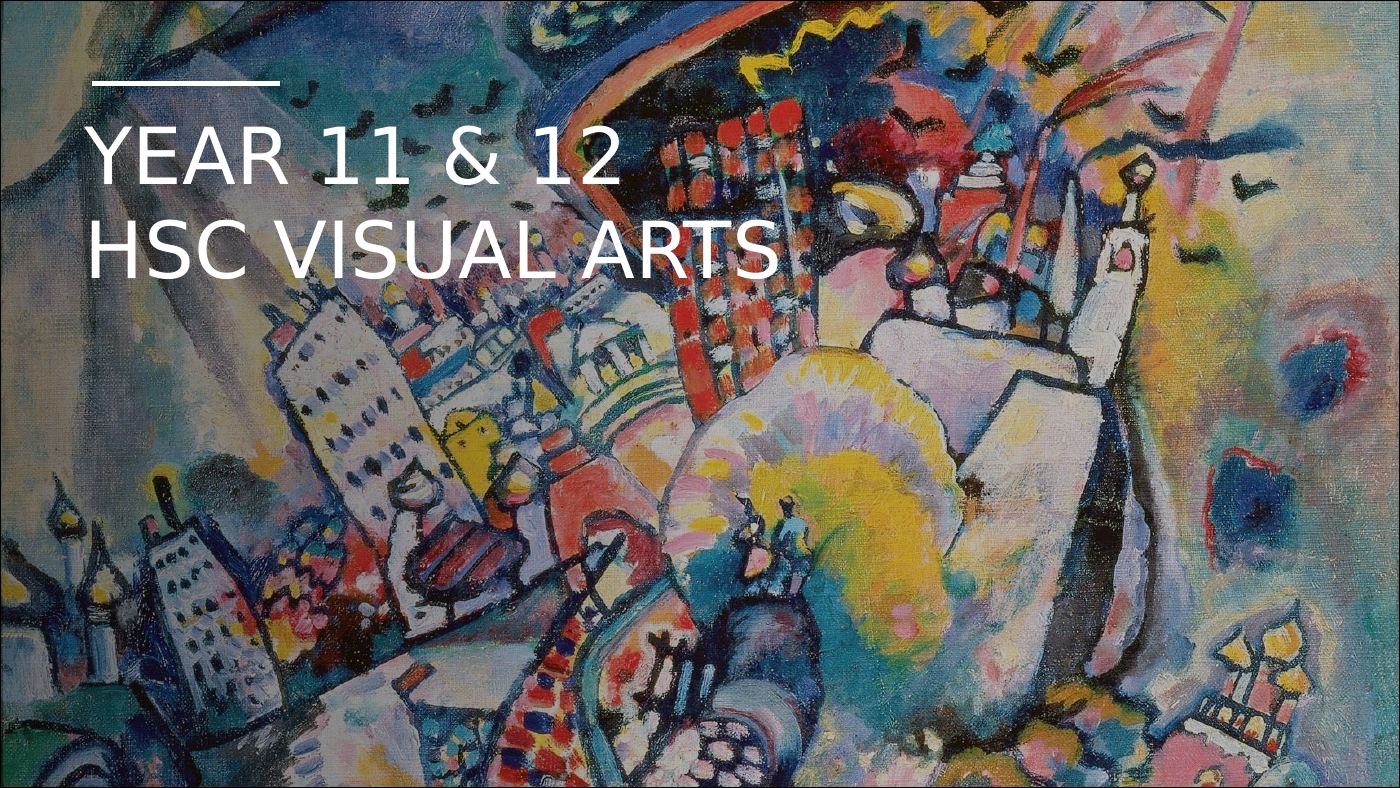
Slide 1
HSC Visual Arts
Year 11 and 12
Visual Arts Stage 6
Slide 2
Why are the Visual Arts important?
Visual Arts builds understanding of the role of art, in all forms of media, in contemporary and historical cultures and the visual world.
It is of great relevance to students’ lives and enables them to gain increasing intellectual autonomy, evident in interpretations of their own work and the work of others.
It places a high regard on how students develop an informed point of view and encourages tolerance, diversity and empathy between students, teachers and others in the expression of different points of view.
It fosters interest and enjoyment in the doing, the production and the consumption of art, while building informed citizens.
Slide 3
Course overview
Preliminary course — 120 hours. Assessment: Artmaking 50%; Art Criticism and Art History 50%.
HSC course — 120 hours. School-based assessment: Development of the Body of Work 50%; Art Criticism and Art History 50%.
HSC external examination: submission of a Body of Work 50%; written paper 50%.
Slide 4
Course structure — Preliminary course
Students learn about the nature of practice in artmaking, art criticism and art history through different investigations.
Agencies in the artworld — artist, artwork, world, audience.
The frames, and how students might develop their own informed points of view.
How they might develop meaning and interest in their work.
Building understanding over time through various investigations and through working in different forms.
Slide 5
Preliminary course — school-based assessment
Artmaking 50% · Art Criticism and Art History 50%.
Term 1 — Landscape: Part 1 submission of landscape paintings; Part 2 extended research essay.
Term 2 — Abstract Expressionism: Task 1 portfolio submission and viva voce presentation; Task 2 half-yearly examination.
School-based assessment: Development of the Body of Work 50%; Art Criticism and Art History 50%.
External examination: submission of a Body of Work 50%; written HSC paper 50%.
Slide 7
Course structure — HSC course
How students may ‘own’ practice in artmaking, art criticism and art history.
How they may further relate concepts of the artworld involving the agencies of artist, artwork, world and audience.
How they may develop their own informed points of view in increasingly independent ways using the frames.
How they may further develop meaning and interest in their work.
Slide 8
Art criticism and art history — case study artists
Students learn about practice in art criticism and art history, which complements and extends their understanding of the visual arts gained in artmaking.
They learn how to evaluate and explain the significance of particular artists, artworks, audience responses and representations of the world.
Case study artists: Ai Weiwei · Jeff Koons · Fiona Hall · Abdul Abdullah · Picasso and Goya · Anselm Kiefer.
Slide 9
Artmaking — art forms to be explored
Students learn about practice in artmaking and how to make art in its various forms within the context of the art room. Critical judgement is central to making informed decisions and developing autonomous knowledge in responding to the world, making artworks and communicating with audiences.
Collection of works · documented forms · photomedia · painting · printmaking · textiles and fibre · sculpture · graphic design · drawing.
Slide 10
Body of Work — expressive forms (1)
Documented forms — an individual work or series of works documenting time-based events, happenings, performances and site-specific installations.
Collection of works — a collection or series of works made using different expressive forms.
Photomedia — an individual work or series of works in black and white or colour using wet (darkroom) and/or digital practices.
Painting — an individual work or series of works with a focus on painting.
Slide 11
Body of Work — expressive forms (2)
Textiles and fibre — an individual work or series of works with a focus on textiles and fibres.
Printmaking — an individual work or series of works with a focus on printmaking.
Sculpture — an individual work or series of works with a focus on sculpture.
Graphic design — an individual work or series of works with a focus on graphic design.
Drawing — an individual work or series of works with a focus on drawing.
Slide 12
Careers and courses
There is a huge range of degree courses around the world in the areas listed below. You will be enriched by the experience of pursuing art at any level. These courses can lead to careers in art, whether Fine Art or Commercial Art.
Fine arts · architecture · photography · art therapy · product design.
Graphic design · animation · industrial design · museum curator · art gallery director.
Illustration · interior design · art education · game design · art conservation.